Aesthetics of AI
Observations on the Visual Identities of Standout AI Brands
Download the full report
Aesthetics of AI
The AI race is running at an incredibly high pace. But product-wise, it has become somewhat monotonous. Each new model beats all others out there, until the next one lands. Everyone integrates everything. Armies of agents are unleashed to create value by connecting the dots in our data, yet they often just get in the way.
From a branding perspective, however, AI is more exciting than ever. As in every crowded market with low product differentiation, brand has become a crucial asset in the fight for attention, authority, and capital.
A perfect moment to dive into the AI space through a branding lens.
From Beige Blandness to Bold Retrofuturism. AI Branding is as Multifaceted as the Technology Itself.
We looked at 23 standout AI brands, big and small, to identify the trends that currently shape visual identities in AI.
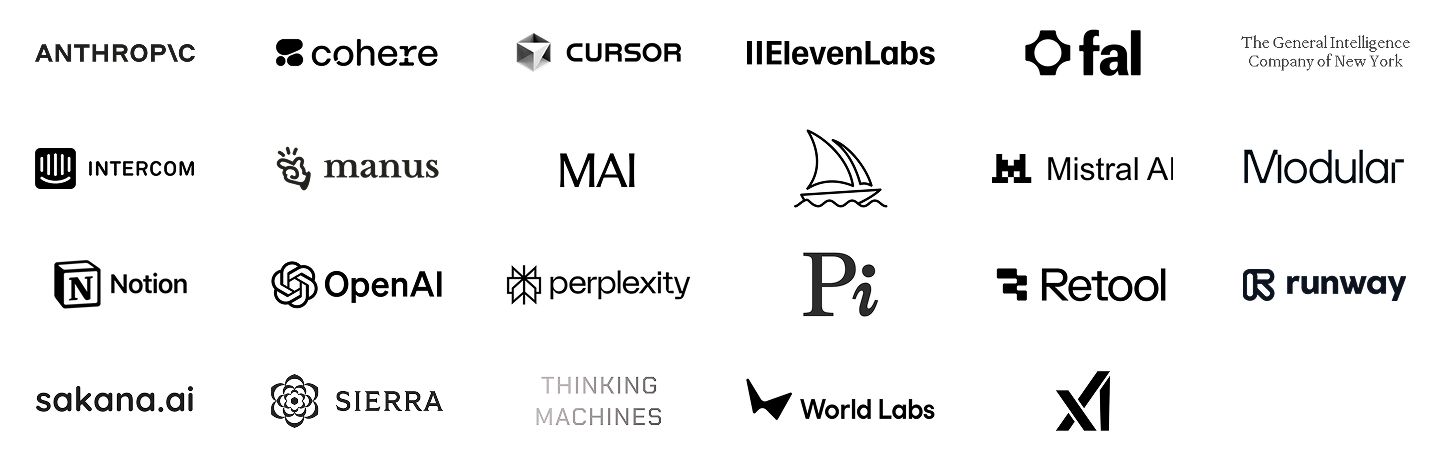
What stands out immediately is that many brands aim for a sense of organic pleasantness, giving a potentially terrifying technology a friendly appeal. Shades of off-white and soft, organic gradients feel calm, approachable, and trustworthy.
On top of these pleasant canvases, many brands use expressive key visuals to create distinctiveness. That makes sense in a space where actual product interfaces are barely differentiated. The spectrum ranges from technical styles like pixel art and CAD-inspired illustrations, focusing on the technology itself, to human-inspired paintings and scribbles that emphasize what the technology enables people to do.
The motifs range from familiar to speculative. Everyday scenes and friendly faces communicate the idea of AI as a tool that is here to make our lives better. Retrofuturistic imagery and mysterious objects, on the other hand, convey AI as a technology poised to radically change the world.

14 Visual Identity Trends that Shape the Battle for Attention, Authority, and Capital in AI
Within this spectrum, we identified 14 trends that currently define visual identities in AI. As with all trends, blindly following them leads to sameness and, ultimately, irrelevance. The real opportunity lies in making conscious decisions: when to adopt, when to ignore, when to push a trend further, and when to deliberately counter it.

1 – Shades of Off-White
The quiet-luxury uniform of AI. Calm, warm, muted palettes designed to reduce friction and avoid visual risk. Signaling trust, restraint, and maturity rather than excitement. Premium without gloss, authority without dominance. A neutral backdrop that deliberately steps aside, allowing products and narratives to take center stage. The Pantone color of 2026 already all over in AI.


2 – Organic Gradients
Gradients are everywhere. They scale effortlessly and go with anything. Looking interesting without saying much. AI itself has figured this out and splashes gradients onto every interface it touches. To differentiate, brands are pushing gradients further. They make them more organic, add grain, texture, and subtle variation. The result is greater distinctiveness and a more ownable visual identity within a crowded and homogenized landscape.


3 – Digital Impressionism
Soft, blurred forms and reduced detail avoid literal representation and instead focus on mood and emotional resonance. By keeping nothing fully in focus, these visuals resist the urge to explain or over-specify what AI is or how it works. The imagery becomes suggestive rather than descriptive, creating space for interpretation and projection. Digital impressionism allows brands to visualize intelligence without making concrete claims they can’t fully control.


4 – Lomo Imagery
Lomography-inspired imagery embraces imperfection as a signal. High contrast, washed-out colors, light leaks, blur, and visible “mistakes” deliberately reject polished, corporate aesthetics. This visual language frames AI as exploratory rather than authoritative — something to play with, not be intimidated by. By referencing analog photography and happy accidents, these brands position themselves closer to human creativity, curiosity, and experimentation. The messiness is intentional: it suggests openness, discovery, and a system still in motion rather than a finished, rigid product.


5 – Contemporary Realism
Contemporary realism serves as both a metaphor for AI and proof of its capability. It makes the invisible tangible and firmly grounds the often blurry, abstract technology in the real world. The style signals precision, control, and craft, creating a sense of reliability and mastery. It sets the brand apart from vague, decorative gradients while hinting at the AI’s uncanny ability to “see” and interpret the world, positioning the technology as advanced yet comprehensible.


6 – Sketch and Scribble
Sketches and scribbles serve as a deliberate counterpoint to machine perfection. Uneven lines, quick marks, and half-formed diagrams create visual traces of thinking rather than finished outcomes. They reference notebooks, whiteboards, and the early moments when ideas are still fragile. In a space dominated by automation and scale, scribbles reintroduce hesitation, curiosity, and human intent. The style signals exploration over certainty and emphasizes the human thought process behind the technology.


7 – Non-Brand Academia
Creating authority in a space where much so-called groundbreaking AI is little more than a GPT wrapper. Stripping visual identity down to essentials, avoiding shine or gimmicks, signaling that the work itself demonstrates innovation. Lean typography, muted colors, and functional layouts emphasize seriousness and credibility. This is the humblebrag of branding: We don’t need a shiny brand; our work speaks for itself. The overall effect is quietly confident, rigorous, and authoritative.


8 – Technical Illustrations
Often not actual visualizations of the technology, but signals of technical competence. They serve more as decoration than communication, referencing engineering, research papers, and system diagrams. Slightly retro in feel, they project rigor, depth, and seriousness. This style borrows the language of documentation, positioning the brand as knowledgeable, precise, and grounded in technical expertise.


9 – Quirky Cuteness
Cute mascots as counterweight to AI doomsday narratives. Humanizing a technology that feels abstract, powerful, and sometimes threatening. Friendly faces for complex systems. Playful, nerdy, self-aware. A bridge to engineering culture and insider humor. Signaling approachability in public and belonging in the war for AI talent.


10 – Morphing Objects
Floating, evolving, constantly in motion. No fixed form. No final state. Shapes that evolve, dissolve, and reassemble. Visualizing emergence rather than outcomes. A metaphor for systems that learn, adapt, and change over time. Signaling novelty, uncertainty, and the unknown. AI not as a finished product, but as something continuously becoming.


11 – Futuristic Surrealism
Some brands build entire surreal worlds. Layered environments, impossible physics, dreamlike machines. Sometimes leaning steampunk, sometimes retrofuturistic, always otherworldly. Less about explaining the technology, more about what it enables. A signal that this AI is not just a tool, but a gateway. An invitation to step into new worlds.


12 – Outer Space
The final frontier. A familiar metaphor for intelligence that still feels undiscovered. Sometimes romantic and utopian. Sometimes undeniably cheesy. Galaxies, stars, cosmic light. AI as exploration. Framing progress as a journey into the unknown.


13 – ASCII and Pixels
Pixelart and ASCII art are back. A nod to early internet and computer culture. Retro by design. Instantly friendly. AI that is here to play, not to take your job. Creative and inspiring, yet clearly technical. Adding familiarity, nostalgia, and a sense of predictability to an opaque technology.


14 – Generative Art
Algorithmic patterns, cellular automata, rule-based visuals. Pixel art for mathematicians. Systems that create form through logic. Flexible and scalable. A natural fit for AI branding, where the visual itself behaves like a product. Less about a single image, more about a living system. A signal of depth, rigor, and emergent complexity.


Five Brand Archetypes Reflecting Different Visions of AI
Every brand we analyzed is clearly unique. Yet, we think that they can be clustered into five archetypes, each setting a distinct tone in the race for attention, authority, and capital. Different key visuals, different signals, different ways of claiming relevance in an increasingly crowded AI landscape.

Likeable Leaders primarily communicate seriousness, stability, and trust. Their color palettes are toned down, often built around muted greys and warm beiges. Nothing sharp, nothing polarizing. Their visual identities avoid friction by design. Impressionistic illustrations and soft gradients are common, used not to explain, but to create a broadly appealing, inoffensive atmosphere. Photography leans human and approachable, presenting the brand as friendly, calm, and responsible. The result is authority without arrogance, leadership without edges.
Gentle Humanists put people before technology. Their brands carry a soft, almost romantic tone. Visuals lean toward human, often hand-drawn illustrations that depict everyday moments, nature, and human interaction. Playful, sometimes bordering on childlike. Deliberately avoiding anything that could read as cold, technical, or potentially threatening. The technology stays in the background. What matters is what people can do with it, how it fits into life, and how it makes things feel. AI as an enabler of human potential, not a force to be feared.
Nerdy Idealists are not about business first, but about exploring a fascinating technology. Their brands are steeped in engineering culture and nerd references. Intentionally unpolished. Sometimes overly playful, sometimes quirky, sometimes deliberately non-branded. Rough edges are part of the signal. They are not trying to look like serious, corporate super-brands. The goal is not to attract consumers, but peers. Fellow builders, researchers, and enthusiasts who care about the technology itself, not the hype around it.
Bold Builders treat AI not as just another technology, but as something truly groundbreaking. They don’t try to soften or humanize its power. Instead, they lean into it. Their brands make AI feel vast, capable, and transformative. Space references are common. The last frontier as a metaphor. Darker color palettes replace off-whites and pastels. Less comfort, more ambition. These brands frame AI as a force that reshapes what’s possible, not something to be domesticated.
Utopian Dreamers talk less about the technology itself and more about what becomes possible because of it. Their brands build expansive creative worlds, sometimes retrofuturistic, sometimes surreal. They communicate optimistic, utopian visions that may confuse or even alienate some audiences, but almost always fascinate. Clarity is less important than imagination. It’s not about the here and now, but about futures yet to be defined. These brands invite people to dream first and understand later, framing AI as a catalyst for entirely new realities rather than incremental progress.
By the time you’ve finished reading this, parts of it are almost certainly already outdated. Some of the brands we analyzed may not even exist anymore. That’s exactly what makes following this industry so exiting. Branding alone won’t make a winner, but a standout brand can provide a meaningful advantage in this high-stakes race for attention, authority, and capital.
Looking for a partner to make your brand stand out in your industry?