Eurocoded
Observations on the visual identities and narratives of European tech brands

For a new gen of tech companies, Europe is more than their hq location. It’s part of their brand identity. We call them eurocoded.
Download the full report
Eurocoded
PDF, 6.2 MB

European Origin as Brand Asset
States are calling for European digital sovereignty. Consumers want alternatives to US Big Tech. Corporations are seeking to reduce their tech stacks’ exposure to geopolitical tensions. European origin is becoming a purchase criterion.
But until recently, European tech wasn't identifiable as European. Tech companies on both sides of the Atlantic ran the same brand playbooks with the same narratives and the same symbolism. They were global brands, aimed at global audiences.
The European unicorns of the last decade carried no European identity. There was a time when startups displayed little badges of origin on their websites, but those were cities, not countries. They said "Built in Berlin," not "Built in Germany" or "Built in Europe." That's starting to change. It now matters where you build, not just what you build.
Tech companies are beginning to identify as European companies. Brands are becoming recognizable as European: fueling the sovereignty narrative, using visual markers of European origin, positioning against the clichés of US tech.
The reasons behind that shift are unsettling. But they're real, and they won't fade anytime soon. Being recognizably European is turning into a positioning edge.
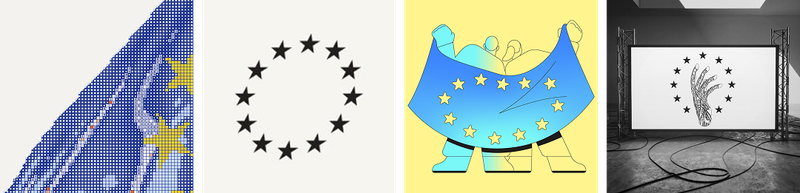
Fieldnotes on Eurocoded Brands
What does eurocoded actually mean? How do European tech brands look, speak, act, and how do they set themselves apart from the US brands that dominate the industry?
To find out, we analyzed the websites and comms material of companies, investors, and initiatives across the European tech ecosystem. We picked 33 organizations that don’t hide their origin in the imprint but, some more openly and some more subtly, feel truly European.
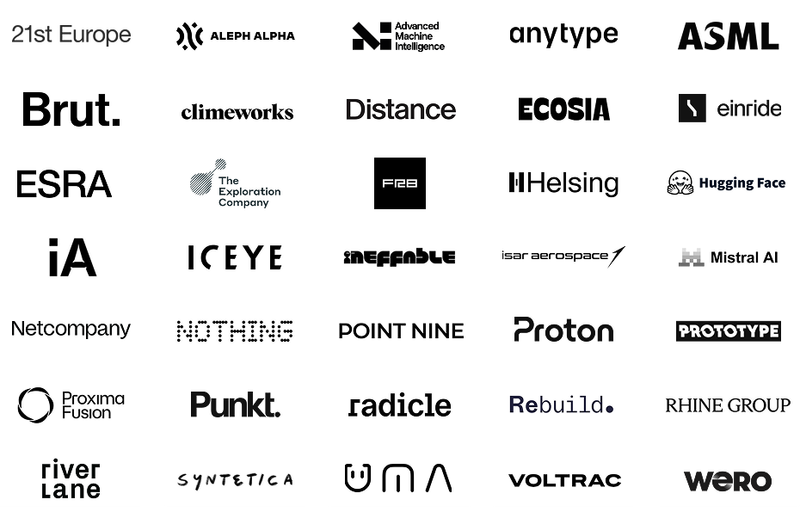
Visual Archetypes
We identified seven archetypes of eurocoded visual identities. Some are more technical and cool, while others feel more human and warm. Some are confrontational; others are more conformist. They’re all very different, but they have one thing in common: they stand apart from the visual clichés of the US tech mainstream.
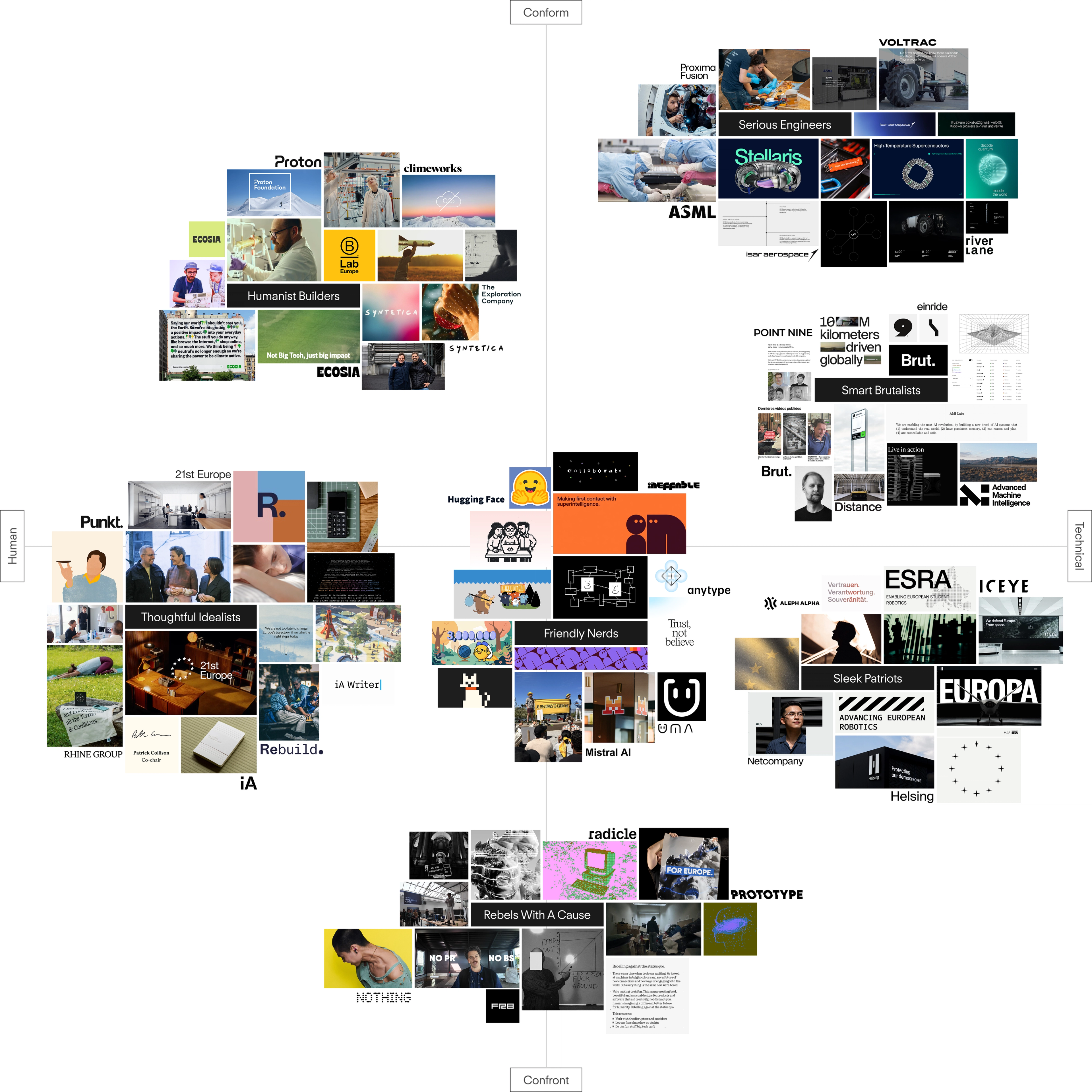
I – Thoughtful Idealists
Tech bros with god complexes. Companies that shred rare books to feed AI algorithms. Services marketed as ways to connect, but designed in ways that leave us depressed. Ruthlessness as a guiding principle: “Move fast and break things.” Big Tech has opened the door for brands that can credibly say: We think about what we do, and we’re actually trying to do good.
Brands like iA or Punkt. present themselves as reflective and considered, built by people who think, not just ship. Warm colors, considered and reduced design. A strong pull toward the offline world, held up as a refuge from a cold, dehumanized digital present.
Media
II – Rebels With A Cause
Some eurocoded brands push back against the aesthetic mainstream in tech. Their brands feel like aesthetic activism, with a mix of raw, unpolished visuals, bold colors, and a certain punk aesthetic.
FR8 looks like the underground version of Y Combinator, flexing a DIY attitude instead of polished corporate blandness. Radicle works with pixelated visuals and loud colors. Nothing positions itself against the overly polished look of Apple and other consumer electronics brands. Prototype exudes rebellious energy with rough-cut videos and propaganda-style merch.
Media
III – Smart Brutalists
Most tech websites today either look as if Claude designed them from start to finish or rely on an excess of design fuss that impresses but also distracts.
Brands like Einride and Distance take a different approach. Logos are flat and built from simple forms. Palettes stay almost colorless: cool neutrals, steel, graphite, and occasional signal tones. Photography feels observed rather than staged. Copy is descriptive and matter-of-fact rather than emotional.
It fits the cliché of the European engineer who may not know how to sell but knows how to build. And in doing so, it signals trust, reliability, and quality.
Media
IV – Friendly Nerds
It feels like there are only two ways for US tech brands to go: either dark and powerful or bland and agreeable, with off-white palettes, organic gradients, and amorphous shapes that offend no one and say nothing. The more US tech players retreat into darkness or blandness, the more distinctly European it feels to be quirky and nice.
Hugging Face stuck with its name and logo, derived from the emoji of the same name, even as it grew into a major company. Anytype spices up its otherwise minimalist look with friendly pixel art. Ineffable, the AI company that raised the biggest European seed round ever, stands out in the AI race with 70s-style colors and quirky figures.
Media
V – Sleek Patriots
Some eurocoded brands convey a new form of pan-European patriotism. The look is technical, rational, and cool rather than nostalgic or emotional.
Subtle variations of the European flag and geographic maps recur throughout. Colors signal seriousness: shades of grey, muted blues, and greens. Clear typography and clean shapes complete the picture.
This visual identity appears naturally among defence tech companies like Helsing, but also at IT solution providers like Aleph Alpha or Netcompany, who see their European origin as a competitive advantage in their home markets against international players.
Media
VI – Serious Engineers
Europe lost the software age but has always been strong in advanced engineering and foundational research. That is why several European tech players operate in fields like physical AI (Voltrac), fusion energy (Proxima Fusion), SpaceTech (Isar Aerospace) and quantum computing (Riverlane).
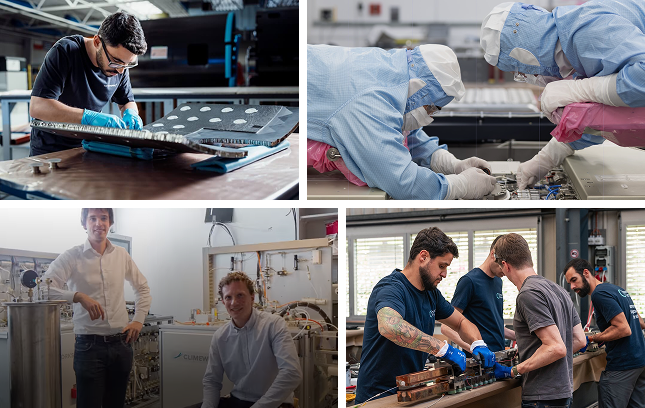
Many of these companies share a similar visual language. Color palettes are dark, cool, and technical. Typography often pairs a clean sans serif with a technical monospace. Photography shows prototypes and people in the middle of their work, not posing for it.
The overall impression is one of seriousness rather than utopian vision, and of deep engineering competence. These brands say: “We know what we’re doing.”
Media
VII – Humanist Builders
A lot of European tech companies try to have a positive impact: there are around 40% more B Corps than in the US despite a similar number of corporations, and the share of all startups with a sustainability focus is nearly three times higher.
Several of them share a visual language: warm, bright colors and real photography showing not staged products but the teams building them. They have a clear identity but are rather unpolished than overly designed. Everything signals: “We’re builders, not dreamers.”, “We exist to create impact today, not in some distant future.” and also “What we do matters more than how we look while doing it.”
Media
Eurocoded Narratives
We identified eight narratives that European tech companies are planting and fuelling. Some of them work as a clear antidote to perceptions of US tech companies. Some respond to the current geopolitical situation. Some are rooted in European heritage. And some flip the prejudices about the European tech sector in interesting ways.
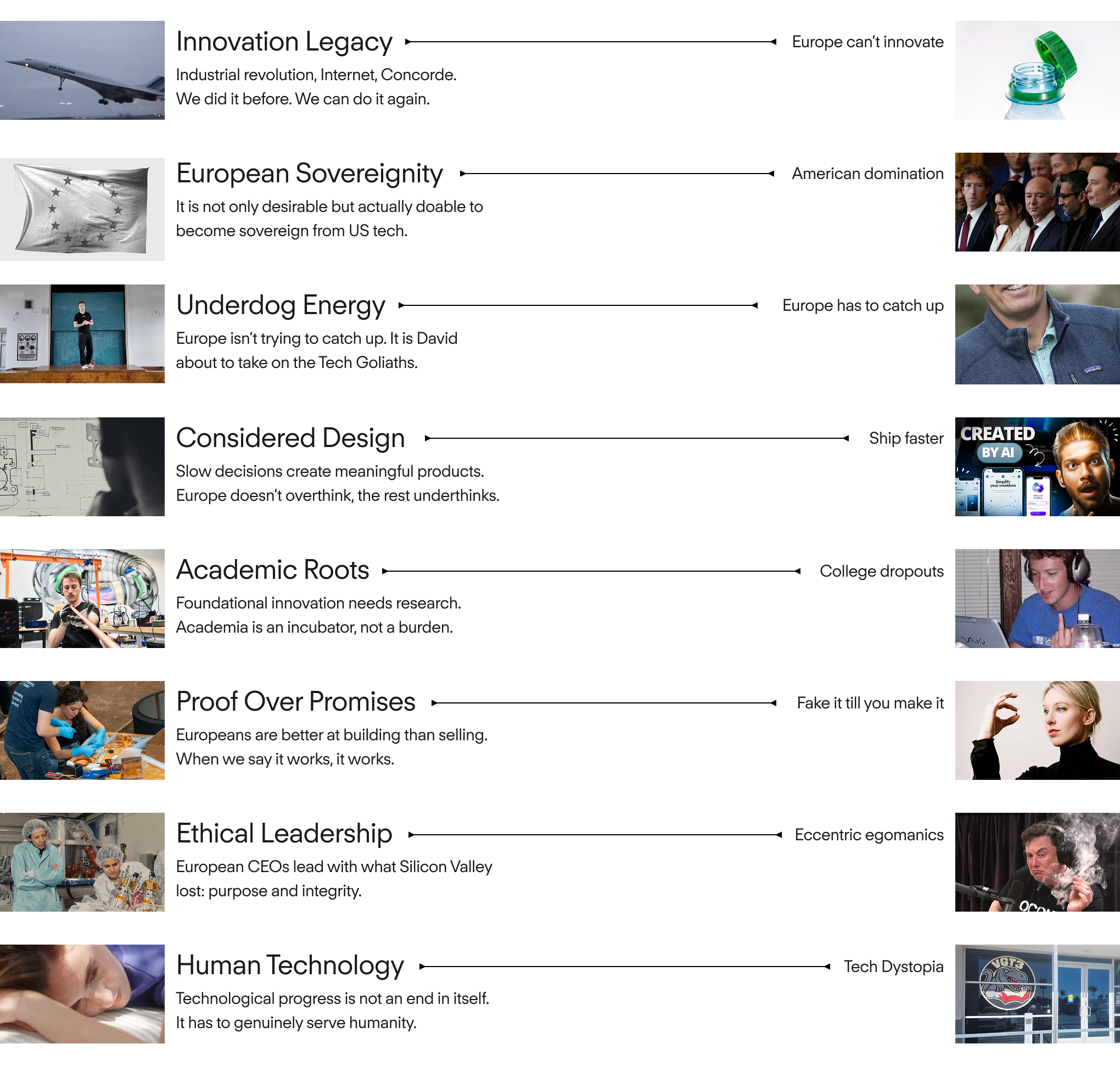
Innovation Legacy
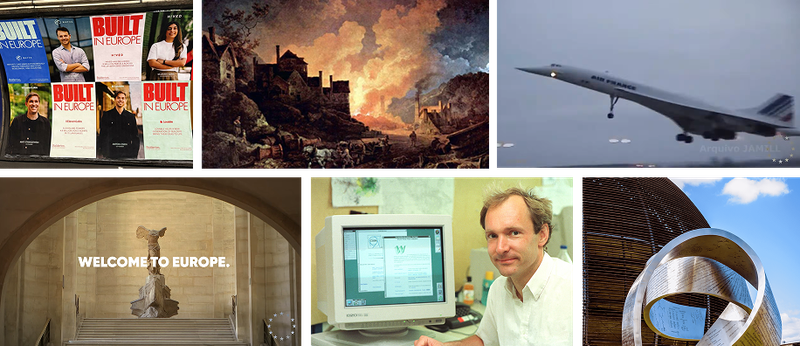
It seems to be a common perception that Europe can’t innovate, but can only regulate. This perception did not come out of nowhere: most of the important innovations that shape our lives and economy today were created in Silicon Valley garages and dorm rooms, not in Europe.
But that is only one part of the story. The World Wide Web was invented at CERN, a pan-European research organization. Linux, the operating system that runs almost every supercomputer and data center, was developed at the University of Helsinki.
European companies are pushing the narrative that Europe was once at the forefront of technological progress and can be again. Proton is proud to have been founded at CERN. The Rhine Group draws on imagery from the Dutch Golden Age. Isembard reminds us that the First Industrial Revolution began in Europe. The VC firms Prototype and Balderton reference technological breakthroughs from European history.
European Sovereignty
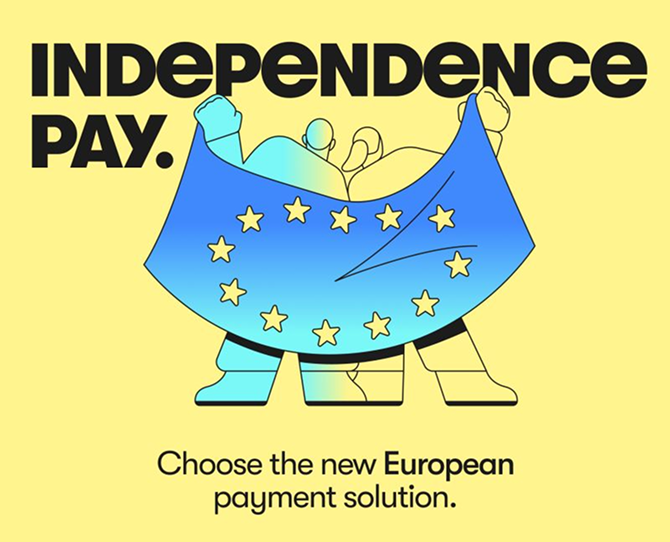
There is clearly a demand for European technology. Consumers want alternatives to Big Tech companies. Governments realize how dependent their critical infrastructure is on US platforms and are pushing for European alternatives. Corporations want their data and supply chains to be protected from foreign leverage.
Yet it is often said that technological sovereignty is impossible because Chinese and US tech companies have such a significant lead.
Many companies and organizations across the European tech sector are fueling the narrative that sovereignty is not only desirable but also achievable.

European sovereignty has become part of mission statements and badges of European origin are proudly displayed on homepages.
Fight The Tech Goliaths

Most European tech companies face dominant US competitors with deeper pockets and stronger ecosystems. The often-repeated analysis is that Europe needs to catch up. Some European companies are flipping the script, communicating that they are not trying to catch up but to attack. This twist moves them from a position of weakness to a position of strength. Underdog energy instead of laggard humility.
Nothing positions itself as David taking on consumer electronics giant Apple. Ironically, Apple built itself on exactly that playbook in the 1980s and 1990s.
This underdog energy runs through the European early-stage sector, too. FR8, a Finnish startup incubator, feels like the underground version of Y Combinator: raw, cool, and energetic. European robotics clubs, such as the one at ETH Zurich, are bursting with ambition and a strong DIY spirit.
What is interesting is how companies are flipping the narrative of old, legacy Europe into one of challenger Europe.
Considered design
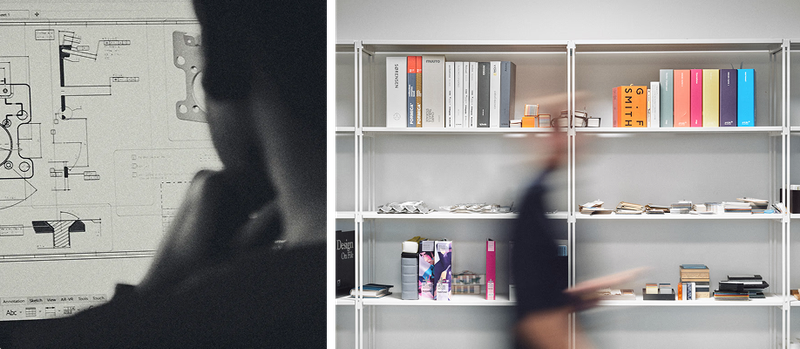
The criticism usually directed at Europe is that it overthinks things: it is too slow, too cautious, and requires too many committees before anything ships. Some eurocoded brands are turning that critique around. They take pride in taking their time with decisions and not jumping on every trend.
Companies like iA stand for lightweight products with fewer, more carefully considered features. They evoke Dieter Rams-style design and send a clear signal that they are more concerned with what should be built than with what could be shipped.
In the age of AI, when everyone can build almost anything, that narrative could be powerful. Thoughtful design as an antidote to AI slop. It could become an advantage for brands if users trust them to release products only when they are meaningful, rather than shipping the next AI feature before anyone has asked whether it should exist.
Maybe it is not that Europeans overthink. It is that the rest of the industry underthinks.
Academic Roots
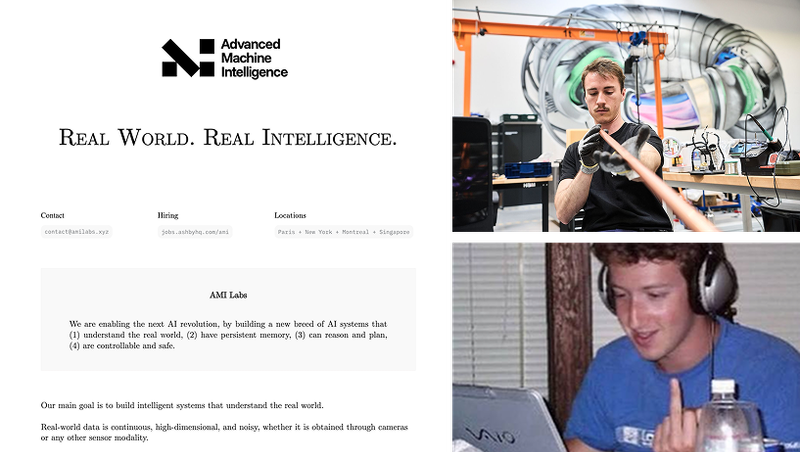
US tech glorifies the college dropout and casts serious doubt on the value of academia. Peter Thiel literally pays people to leave university and build instead. Some European startups do the opposite: they embrace their academic roots as a badge of credibility rather than something to escape.
Proton is proud to trace its origins to CERN, the research institution where the web was born. Proxima Fusion draws on its Max Planck Institute heritage, building on decades of stellarator research rather than promising a breakthrough from nowhere. AMI Labs builds its entire brand around the aesthetic of a scientific paper. Punkt. maintains an ongoing collaboration with European design schools.
Academic roots signal depth and trust. They are proof that someone did the work before shipping the product.
Proof Over Promises
US tech has always been good at painting grand visions, and in today’s overheated market, it is doing so again. Data centers in space, anyone? But it also has a track record of broken promises. Remember when Elon Musk pledged to put one million robotaxis on the streets by 2020? Or Theranos and its revolutionary single-drop blood test?
Compared with that, many European companies and founders come across as too down-to-earth and not ambitious enough. More engineers than visionaries. They show real prototypes instead of glossy concept videos.
But the stereotype of the honest engineer, great at building and less skilled at selling, can be an asset, too. It builds trust that promises will be kept, that data is actually safe, and that services deliver real value.
Ethical Leadership

Many European tech CEOs come across as the antidote to the familiar US tech CEO. Humble seriousness instead of eccentric rock-star behavior. You get the sense that the CEOs of Ecosia, Proton, and The Exploration Company genuinely take their companies’ mission statements seriously. Almost every tech company has a nice-sounding mission. But who actually believes that Meta is here to build the future of human connection?
For some European tech companies, the mission is not just a nice sentence on the About page. It is deeply embedded in the organization. Ecosia dedicates 100% of its profits to climate action. Its founder has given away his entire financial stake under a steward-ownership model. Proton has a nonprofit foundation as its primary shareholder, helping ensure that the company serves the world, not just its shareholders. The Exploration Company is one of Europe’s fastest-growing space tech companies and the only major player with B Corp certification.
At a time when trust in US Big Tech companies and their leaders is at an all-time low, moral integrity and trust can become a competitive advantage.
The Good Life
The early days of the digital revolution were filled with hope for a better future. But many people have lost faith in Silicon Valley’s ability to change the world for the better.
“Don’t be evil” gave way to tech monopolies harming our mental health, shredding rare books to feed algorithms, and running large-scale tax avoidance schemes. New technology feels threatening rather than promising to many. A majority of people don’t believe AI will be net positive for humanity.
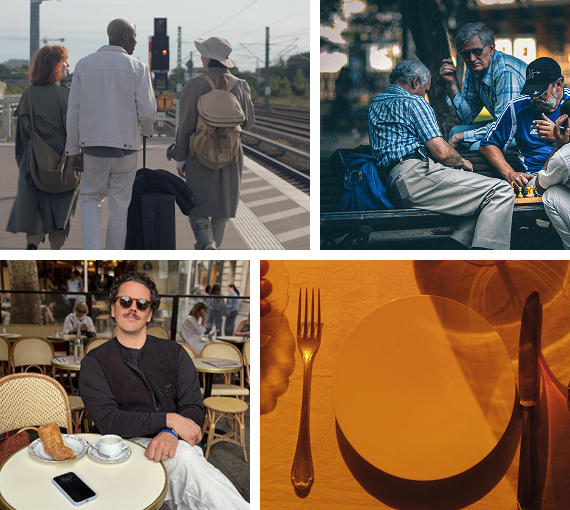
Many eurocoded brands are bringing back the hope of the early digital revolution. They paint almost naively optimistic pictures of a future in which new technology actually serves humanity.
Some openly address the desire many people have for a life in which technology plays a smaller role, not a larger one. They celebrate the slow life, social connections, and cultural experiences. This feels extremely European on the one hand and slightly out of step with the race for technological progress on the other. But maybe that’s exactly the future worth building.
Download the full report
Eurocoded
PDF, 6.2 MB
Closing Thoughts
We did this report to understand what eurocoded actually means. What does it look like, sound like, and act like?
It became clear that there is no single answer. European tech brands are as diverse as Europe itself. The term feels still fuzzy. But it’s clear that more and more European tech brands are making their origins part of their brand identity.
On the one hand, this makes sense because there is a market for European tech. On the other, “European” is still fundamentally associated with negative qualities in tech: underfunded, not hard-working enough, not ambitious enough, not innovative enough.
That doesn’t have to remain the case. All these brands are currently redefining what eurocoded means. They are recoding the label.
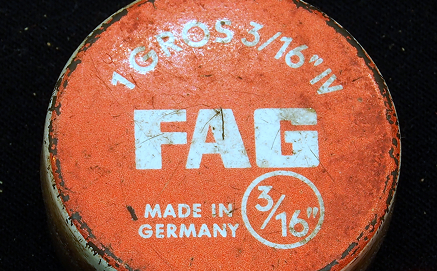
Think about “Made in Germany.” What started in 1887 as a badge used in Great Britain to identify foreign products of inferior quality eventually became a mark of quality. The brands that wore the label redefined what it meant. They flipped the script.
Eurocoded brands have the chance to flip the script once again.